Cleveland QLD 4163 

2026 Best Wall Box Charger for Global Buyers?
Choosing the 2026 Best Wall Box Charger for Global Buyers requires more than comparing charging speed and price. A reliable model must work with local voltage, vehicle standards, climate conditions, and household wiring. It should also provide clear energy data, secure software, and dependable customer support.
Claas Bracklo, a charging-industry specialist and former CharIN chairman, has emphasized, “Interoperability is the key to the mass adoption of electric vehicles.” That principle remains practical. A charger may look powerful on a showroom wall, yet perform poorly with an undersized cable or unstable home network. Small details matter.
This guide examines Wall Box Charger options through real-world buying conditions. We consider output power, connector compatibility, installation requirements, app quality, warranty coverage, and safety certifications. We also compare performance in cold driveways, hot garages, and regions with inconsistent electricity supply. Global buyers need flexibility.
No ranking is perfect.
A premium charger is not automatically the best choice. Some drivers may gain more from load balancing than extreme charging speed. Others may prefer simple controls over a complicated mobile app. These differences deserve honest attention.
The strongest choices combine measurable performance with practical ownership experience. We will highlight suitable models for apartments, private homes, fleets, and renewable-energy systems. The final decision still depends on the vehicle and electrical service. Check both before purchasing. A thoughtful choice can reduce installation costs, charging frustration, and wasted energy over many years.
Define EV Wallboxes: AC 3.7–22 kW Under IEC 61851
2026 Best Wall Box Charger for Global Buyers?
Define EV Wallboxes: AC 3.7–22 kW Under IEC 61851
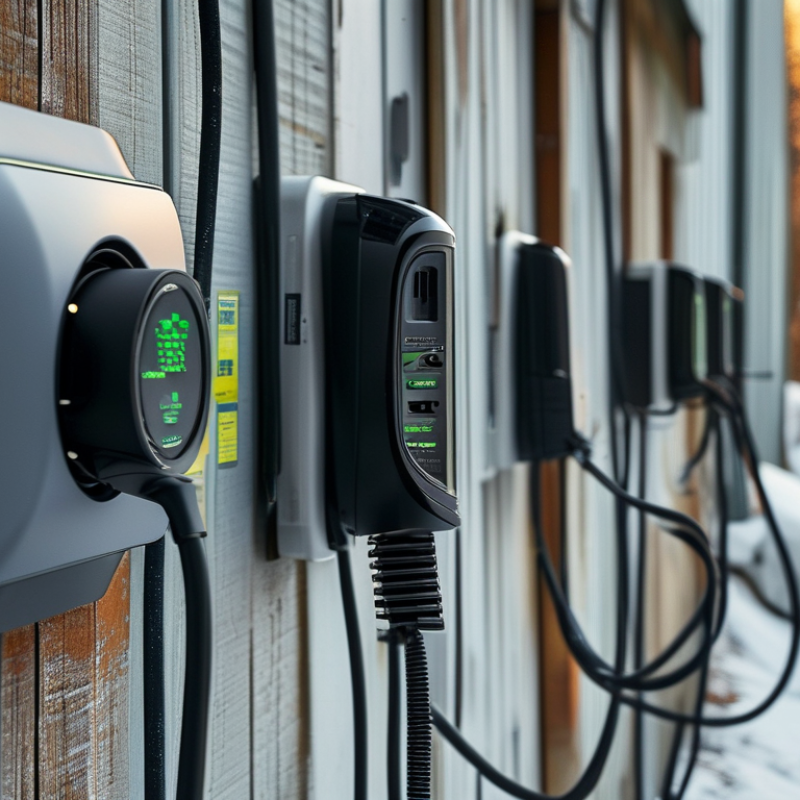
An EV wallbox is fixed charging equipment for home, workplace, or shared parking. In common market use, AC wallboxes range from 3.7 to 22 kW. IEC 61851 defines conductive charging requirements, including Mode 3 communication between the charger and vehicle. The wallbox controls safety signals, while the vehicle’s onboard charger converts AC into battery power.
Power ratings need careful interpretation. A 3.7 kW unit usually suits single-phase, lower-current installations. An 11 kW unit commonly uses three-phase supply at 16 A per phase. A 22 kW unit may require three-phase 32 A service, which many homes cannot support. Cable length, ambient heat, grid limits, and vehicle acceptance also reduce real output.
The IEA’s Global EV Outlook 2025 reported more than 17 million electric cars sold globally in 2024, exceeding one-fifth of new-car sales. Its analysis also highlights rising demand for residential charging. ACEA’s European vehicle charging reports show infrastructure growth remains uneven across countries. That matters for global buyers.
A higher number is not always better.
Before selecting a wallbox, verify local voltage, phase capacity, protection requirements, connector compatibility, and the car’s maximum AC input. Smart load management can prevent nuisance trips, but it cannot create extra grid capacity. This is where product sheets often oversimplify the installation.
2026 Best Wall Box Charger for Global Buyers? - Define EV Wallboxes: AC 3.7–22 kW Under IEC 61851
| Power Class | Typical Electrical Supply | Maximum AC Current | Charging Power | Approx. Time for 60 kWh Battery | Best-Fit Applications | Global Buyer Considerations |
|---|---|---|---|---|---|---|
| Single-phase entry | 220–240 V AC, 1 phase | 16 A | 3.7 kW | About 16–18 hours | Overnight home charging, plug-in hybrids, low daily mileage | Suitable where household circuits or service capacity are limited; final installation rating depends on local electrical rules. |
| Single-phase standard | 220–240 V AC, 1 phase | 32 A | 7.4 kW | About 8–10 hours | Most residential properties with single-phase service | A common 230 V configuration in Europe, Australia and other markets; vehicle onboard-charger limits may reduce actual power. |
| Three-phase standard | 380–415 V AC, 3 phase | 16 A per phase | 11 kW | About 5.5–7 hours | Homes with three-phase supply, workplaces, apartments and destination charging | Requires compatible three-phase infrastructure and a vehicle capable of accepting approximately 11 kW AC. |
| Three-phase high power | 380–415 V AC, 3 phase | 32 A per phase | 22 kW | About 2.8–3.8 hours | Commercial sites, fleets, workplaces and homes with suitable high-capacity service | The vehicle must support 22 kW AC; otherwise the wallbox automatically operates at the vehicle’s lower limit. |
| Evaluation Dimension | Recommended Specification or Requirement | Why It Matters to Global Buyers |
|---|---|---|
| Charging standard | IEC 61851-1 conductive AC charging, normally Mode 3 | Mode 3 provides control-pilot communication, current signaling and controlled energization between the EV and the charging equipment. |
| Vehicle connector compatibility | Type 2 under IEC 62196-2 for many European and international markets; Type 1 under SAE J1772 remains common in North America and selected Asian markets | Connector choice must match the vehicle inlet, local regulations and whether the wallbox uses a socket or a permanently attached cable. |
| Input frequency | 50/60 Hz support is preferable for international deployment | Electrical frequency varies by country; the product nameplate and installation documentation must support the target grid. |
| Residual-current protection | Protection against AC residual current plus DC residual-current detection; installation may require an RCD Type A with 6 mA DC detection or an RCD Type B, subject to local code | EV charging can produce smooth DC residual current, so the protection arrangement must be selected according to the wallbox design and national regulations. |
| Load management | Adjustable current, dynamic load balancing and optional solar or energy-management integration | These functions help prevent service overload and can make higher-power charging practical where available capacity changes during the day. |
| Outdoor protection | At least IP54 for many outdoor installations; higher protection may be preferred for exposed locations, with impact resistance selected for the site | Ingress and impact ratings affect durability, but the enclosure rating does not replace correct mounting, drainage and cable management. |
| Operating temperature | Select a model whose declared range covers the installation climate; many products target approximately −25 °C to +50 °C | Extreme heat or cold can reduce available current, affect cable flexibility or require thermal derating. |
| User access and communications | RFID or app access, optional Ethernet/Wi-Fi/4G, and OCPP support where backend management is required | Connectivity requirements differ between a private home charger and a managed workplace, apartment or fleet installation. |
Notes: Charging-time figures are indicative ideal estimates for adding approximately 60 kWh to the battery and assume suitable vehicle acceptance, installation capacity and normal charging losses. Actual results vary with battery state of charge, battery temperature, onboard-charger rating, cable limits and local electrical regulations. Always verify the applicable national installation code before commissioning.