Call now: 0407 696 866
Choosing the best Electric Scooter Bike in 2026 starts with an honest look at your daily routes. A short, smooth commute asks for different features than a long ride over cracked pavement or steep hills. Picture the details: a battery that must last through the return trip, tires that meet wet streets, and a frame you can lift up a few stairs. Small inconveniences add up. The most impressive specification sheet may not match your actual routine.
This guide explains how to compare range, motor output, charging time, braking, comfort, and carrying weight. It also looks at practical details that product listings can hide, such as replacement-part availability, warranty terms, and whether the controls feel clear while riding. Numbers are useful, but advertised range can change with rider weight, temperature, hills, and speed. Still, numbers mislead. Use them as estimates, not promises. A careful test ride, where available, can reveal an awkward handlebar position or a seat that feels fine for five minutes but not for a longer trip. There is no perfect model for everyone, and some trade-offs are easy to overlook. Comparing your needs with verifiable specifications and reliable support can help you choose a scooter bike that feels sensible—not merely exciting in a showroom.
Before comparing electric scooter bikes, map the trips you actually make each week. Note the distance, road surface, hills, traffic, and places where you must walk or carry the vehicle. Your daily route matters more than a headline range. A smooth, flat commute asks for different features than cracked pavement, steep streets, or frequent curb cuts. Small details count.
Check your route at the times you expect to ride. A quiet street at noon may feel crowded during the morning rush, while rain can make painted road markings slippery. Look for safe places to park and charge, too. If stairs or a crowded bus are part of your journey, overall weight and folding ease may matter more than top speed. For longer trips, leave a range buffer: cold weather, hills, heavier loads, and repeated stops can reduce battery performance. Manufacturer estimates are useful comparisons, not guarantees. A short test ride on similar terrain can reveal whether the riding position, braking, and handling feel comfortable. I might be tempted to choose the fastest option, but speed is less helpful if the route feels stressful or the bike is awkward to store. Consider the boring parts.
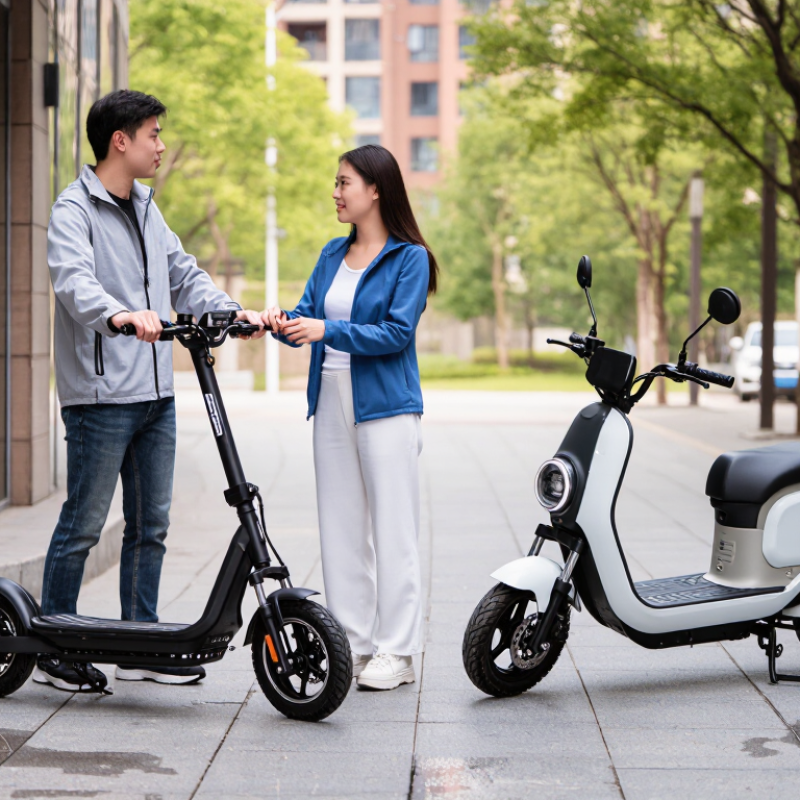
Choosing an electric scooter or bike in 2026 starts with comparing how each design fits your daily route. A scooter’s standing deck and upright handlebar position make quick trips feel simple. Its compact frame can be easier to store near a desk or in a hallway. But small wheels may feel less settled on cracked pavement. Test the actual surfaces you ride. That detail matters.
An electric bike uses a saddle, pedals, and usually larger wheels. This layout can feel steadier over rough streets, while pedaling gives you another way to keep moving. The trade-off is size: many bikes need more storage space and can be awkward to carry upstairs. Frame shape also changes comfort. A step-through design is easier to mount; a higher top tube may feel more secure to some riders. Fit is personal, not a spec-sheet victory.
Compare more than appearance. Check the handlebar reach, deck or saddle height, tire width, braking feel, and where the battery adds weight. If possible, ride each design over the same short route, including a turn and a rough patch. Notice whether your wrists, knees, or shoulders tense up. I find this part easy to overlook when comparing numbers online. It is not a perfect test, but comfort after ten minutes can reveal a mismatch that a range estimate cannot.
When choosing an electric scooter bike, compare its stated range with your actual route. A 30-mile claim may assume a light rider, warm weather, and steady travel on flat pavement. Hills, cold mornings, frequent stops, and extra cargo can reduce distance. Leave a comfortable buffer rather than planning to use every advertised mile. Numbers can mislead.
Motor power affects hill climbing and acceleration, but peak power is not the whole story. Check the continuous rating, then test the bike on a slope similar to your commute if possible. Notice whether it pulls smoothly from a stop or struggles when carrying a backpack. A stronger motor may also use more energy. That trade-off is easy to overlook.
Look at battery capacity in watt-hours, not just voltage, and check whether the battery can be removed for indoor charging. A charger that restores a partly drained battery overnight may suit daily use; a large battery can take much longer. Ask for the estimated full-charge time and inspect the charging port and cable for a secure fit. Battery figures still cannot predict every ride, and I would treat them as estimates, not promises.
Compare battery capacity with estimated range, then check motor power and charging time against your daily needs.
| Battery capacity | Common nominal motor class | Approx. full charge time* |
|---|---|---|
| 500 Wh | 250–350 W | About 4 hours |
| 750 Wh | 350–500 W | About 6 hours |
| 1,000 Wh | 500 W and above | About 8 hours |
Range estimates assume energy use of roughly 15–25 Wh/km. Actual range varies with rider and cargo weight, speed, hills, temperature, tire pressure, and riding style. Charging estimates assume a charger rated around 150 W and allow extra time for charging losses and the battery’s final charging phase; check the specific battery and charger specifications before buying.
Before comparing speed or range, inspect the safety features you will rely on every day. Look for responsive brakes, bright front and rear lights, reflectors, and tires suited to the surfaces you use. Check the frame, folding latch, and battery housing for clear instructions and signs of solid construction. Small details matter. A quick test ride can reveal wobbly steering or brakes that feel weak, but it cannot replace checking the manual and maintenance requirements.
Fit matters, too. Stand over the scooter and confirm you can reach the controls without stretching or hunching. The handlebar should feel steady, and your feet should sit comfortably on the deck. A scooter that feels manageable indoors may feel heavy when carried up stairs. I would not trust a brief showroom ride alone; real pavement can expose awkward handling. Before buying, check your local transport authority’s current rules for where scooters may be ridden, required equipment, age limits, and speed restrictions. These rules vary by location and can change. Save the official guidance, and confirm that the scooter’s specifications meet it.
| What to Check | Useful Facts or Measurements | How to Choose | Questions to Verify |
|---|---|---|---|
| Brakes | Electric two-wheelers may use mechanical or hydraulic disc brakes, drum brakes, or other braking systems. Braking distance changes with speed, rider weight, tires, road surface, and weather. | Look for dependable front and rear braking, easy-to-reach controls, and a clear way to check brake wear. Test the brakes at low speed in a safe area before regular use. | Can the brakes stop the vehicle smoothly? Are replacement pads or other wear parts available? Does the owner’s manual specify routine inspection? |
| Lights and visibility | Front and rear lights help other road users see the rider. Reflectors and reflective clothing can improve visibility, especially in low light. | Choose working front and rear lights, plus reflectors where required. Check whether lights run from the main battery and whether they remain usable as the battery charge falls. | Are the lights bright and positioned so they are visible? Are additional reflectors or a bell required where you ride? |
| Tires and traction | Tire pressure, tread, width, and condition affect grip and handling. The recommended pressure is usually printed on the tire or stated in the manual. | Choose tires suited to your usual surfaces. Inspect them for cuts, embedded objects, and wear, and keep pressure within the manufacturer’s stated range. | Are the tires suitable for wet pavement or rough paths? Can you obtain the correct replacement size? |
| Battery and charging | Lithium-ion batteries need compatible chargers and careful handling. Battery range varies with rider and cargo weight, speed, hills, temperature, tire pressure, and battery age. | Use only the supplied or approved charger. Charge on a stable surface away from exits and combustible materials, and stop using a battery that is swollen, damaged, unusually hot, or leaking. | What charging and storage instructions does the manual give? Is the battery removable, and how can it be inspected or serviced safely? |
| Frame and load limit | Every vehicle has a maximum load limit set by its manufacturer. The total load may include the rider, clothing, bags, and accessories. | Stay within the stated limit and check that the frame, folding mechanism, handlebars, and fasteners are secure before riding. | Does the published load limit cover your expected total load? Are there clear instructions for checking the folding latch and fasteners? |
| Rider fit | A comfortable riding position depends on rider height, handlebar reach, deck or pedal position, and the vehicle’s adjustment range. | Stand or sit in a relaxed posture with a secure grip and room to steer. For a bicycle-style model, check that the saddle height allows controlled pedaling and a safe stop. | Can the handlebar or saddle be adjusted? Can you reach the controls without stretching or losing a stable stance? |
| Stability and handling | Wheel size, wheelbase, steering geometry, suspension, and total weight affect how a vehicle feels. A heavier model can be harder to carry or maneuver when not powered. | Try turning, braking, and mounting or dismounting at low speed in a permitted, low-traffic area. Choose a model you can control and move comfortably. | Does it feel stable at the speeds you expect to use? Can you lift or store it safely if needed? |
| Helmet and protective gear | Helmet requirements differ by location, vehicle type, and rider age. A properly fitted, undamaged helmet designed for cycling or the applicable vehicle category can reduce the risk of head injury. | Wear a correctly fitted helmet and consider gloves and visible clothing. Replace a helmet after a significant impact and follow its care instructions. | What helmet standard and age rules apply locally? Does the helmet sit level and stay secure when fastened? |
| Speed and vehicle classification | Legal speed limits, power limits, age rules, and permitted vehicle categories vary by country, state, province, and municipality. A model’s advertised top speed does not determine where it may legally be used. | Check the official transport authority’s rules for the exact vehicle type before buying. Confirm whether modifications can change its legal classification. | Is this model classified as an electric scooter, powered cycle, moped, or another vehicle locally? Are registration, licensing, insurance, or age requirements applicable? |
| Where you can ride | Access rules for roads, cycle lanes, sidewalks, shared paths, and parks differ between jurisdictions and may also depend on signs or local restrictions. | Check local government and transport-authority guidance for your intended routes. Do not assume that a route open to bicycles is automatically open to every powered vehicle. | Which roads and paths permit this vehicle? Are there local parking, carrying, or no-ride-zone rules? |
| Weather and water exposure | Water-resistance ratings, if provided, describe specified test conditions; they do not make a vehicle suitable for every storm, submersion, or wet-road situation. | Follow the manual’s limits for rain and cleaning. Reduce speed on wet surfaces, avoid standing water, and dry the vehicle as instructed before charging. | Does the manual state an ingress-protection rating or wet-weather restrictions? Are the brakes and tires suitable for your typical conditions? |
| Maintenance and support | Brakes, tires, lights, fasteners, and battery condition need periodic checks. Service intervals and repair procedures depend on the model. | Review the manual and confirm that essential parts and qualified service are accessible before purchase. Keep a record of inspections and repairs. | Are maintenance instructions available? Can the tires, brake components, and battery be serviced or replaced safely? |
Before buying: Confirm the vehicle’s exact classification and current rules with the official transport or local government authority where you plan to ride. Regulations can change and vary by location.
When comparing electric scooter bikes in 2026, treat the sticker price as only the opening number. Add expected battery, tire, brake, and service costs over three years. Charging is usually modest. The U.S. Energy Information Administration reported an average residential electricity price of 16.48 cents per kilowatt-hour in 2024. At that rate, charging a 0.5-kWh battery costs about eight cents before charging losses. Your local rate may differ.
Battery replacement can change the calculation. BloombergNEF’s 2024 battery price survey put the average lithium-ion pack price at $115 per kilowatt-hour. That is a market benchmark, not a retail quote for a scooter battery; casing, electronics, labor, and shipping add cost. Ask for the replacement price and part number in writing. A cheap scooter can become expensive when a specific battery is unavailable.
Read the warranty beyond its headline duration. Check whether it covers battery capacity loss, labor, and shipping, and whether water exposure is excluded. Ask how long common parts remain available and who handles repairs. A long warranty sounds reassuring, but slow support can still leave a scooter unusable. Small detail, big difference. Compare the total expected cost, then keep a little room for surprise repairs. I would not assume the lowest-cost option stays cheapest; battery health and parts access are hard to predict.